
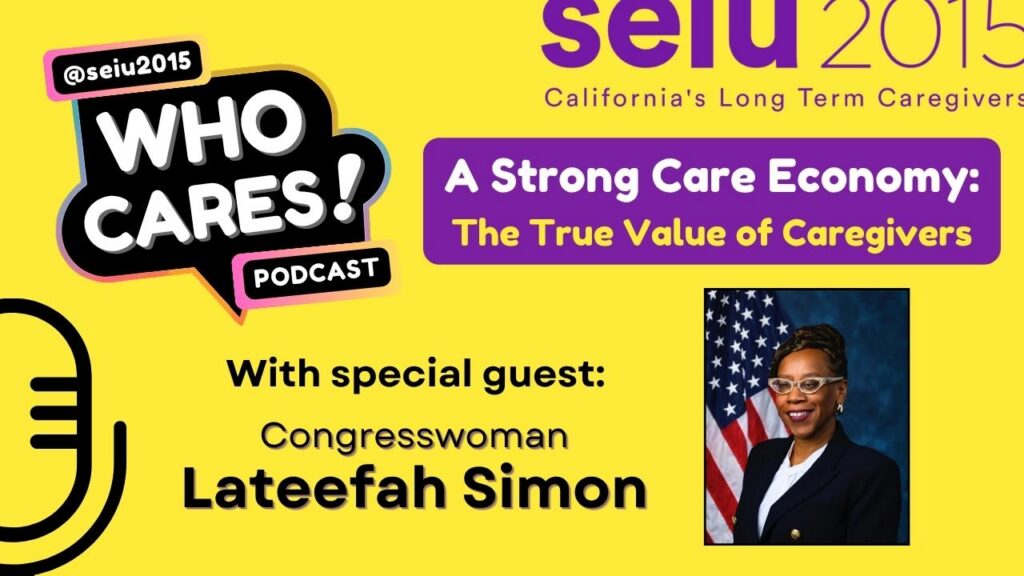
SEIU 2015 Executive Vice President Kim Evon sits down with Congresswoman Lateefah Simon for a conversation on care, leadership, and lived experience – and why valuing caregivers is key to a more just future. She shares how her journey informs her work in Congress and the urgent need to invest in the care economy. Learn about Rep Simon’s aim to uplift long-term care workers and champion economic justice for all.
As the 2026 primary elections approach, learn how you can support candidates who prioritize organized labor and care workers’ rights at seiu2015.us/PrimaryBallot2026
Transcript
Kim Evon
Welcome to Who Cares, everybody, a podcast by SEIU 2015. Today, I’m your host, Kim Evon, Executive Vice President of SEIU 2015 We’re the largest union of long-term care workers in the country, and we represent over half a million caregivers who show up every single day to care for older adults and people with disabilities all over California.
And today’s conversation is about the future of care, what it will take to build a care economy that is strong, affordable, and accessible for everyone, and when we say a care economy, we mean everything that helps us care for the people we love, while still being able to work and live our lives, that includes care workers, families, and the policies and public investments that make care possible. No matter how people identify politically, most of us share a basic belief that people should be able to care for their children, their parents, their elders, and their loved ones, and still be able to provide for themselves and live with dignity.
Everyone should be able to receive compassionate care across the stages of our lives, but right now that system is under real pressure. We’re seeing billions being cut from Medicaid and policies that put corporate profits ahead of people’s basic needs. So, the question is, what would it take to build a care system that actually works for everyone?
And I am so excited to be joined by somebody who I think is an amazing leader, organizer, woman who is taking charge in the capital and really representing this notion of what it means to center care, she represents the California’s 12th congressional district in the US House of Representatives, which includes Oakland, Berkeley, and wider parts of the East Bay. She has experience as an organizer, an advocate, and a single mother in the disability justice movement that really shaped her work. She’s in Congress, taking on a leading role in advancing care policy, and she’s a co-chair of the Democratic Women’s Caucus Caregiving Task Force, which is why we have her on this podcast today. Please join me in welcoming our sister, Congresswoman Latifah Simon.
Latifah, how are you?
Lateefah Simon
Hey, sister, it is so wonderful to be in conversation with you now more than ever.
Kim Evon
Well, we have so much to talk about, but first, as the largest union of home care workers in this country, we ask all of our guests to share a personal care story. Would you mind sharing a time where you gave or received care, or saw the impact of a caregiver first hand?
Lateefah Simon
I love this question, because I’ll talk about me, but I’ll also let’s make it clear everyone in this country has a care story, and what we have to do is lift those stories, whether you’re wealthy or you’re at the bottom of the poverty line, someone has taken care of us.
My mother, she was a low-income single mom, and enrolled in an amazing program in San Francisco at John Adams College, which is a community college. When my sister and I were very, very young toddlers, and she learned how to take care of veterans with pacemakers, and she didn’t have child care, and so she looked all over the city. She tells me this story all the time, looked all was on a ton of lists, and this was in the late 70s, and found a child care center under a low-income housing complex in the Fillmore district, where we lived, and I remember what was called the Pink School, with all of these amazing teachers. Literally, they taught my sister and I how to read, how to use knife and fork, how to be in a beautiful place where we actually felt safe and special. We were actually in a place where we could grow and we can thrive.
Now that was at the very beginning of my life. Never did I think that, you know, some 30 plus years later, that I would be taking care of my terminally ill husband. And when you get a cancer diagnosis, particularly a terminally ill cancer diagnosis in this country, your life changes forever, whether you’re the caretaker or the patient. And for me and my children, all we had was one another in our community, and I learned so much from our nurses and from other caregivers of how to provide dignity and care for my husband, literally until the day he died.
And that meant, you know, you know what this means. It’s everything, it’s the bathing, it’s the praying, right, it’s the cleaning out the central line, it’s finding a way to get to chemo, it’s figuring out transport upon getting released from the hospital, and it’s sitting with someone while they might not spend the rest of their lives with you, or you’re not spending the rest of their lives with them, you’re you’re there for them until the day that they die in terminal situations, and it shaped me, not only in our own family, but going through cancer, I met so many partners, and so many children, and so many caregivers.
I remember the first nurse who came to our home and taught me how to clean a central line, and I was so scared, one mess up and your loved one could end up in an emergency, and/or worse. And she was so patient with me. That situation, that life-changing few years, it has further shaped my understanding about what Americans are facing every single day, as our people that we love get old, and as our folks battle with devastating, chronic, and terminal illnesses, they deserve and need people there who are going to be, whether they’re family or they’re paid. It’s critical, and again, we all will have a care story, but again, every day that I’m in this capital, I think about my days, particularly the last days with Kevin, and how special they were, and how supported we were, and you know, damn it, I want that for everybody.
Kim Evon
Yeah, thank you so much for sharing that story, and I think it’s one that, like, so many people can connect with, Congresswoman. And you’ve also laid out to me like a journey–a journey which we sometimes don’t step back and reflect on, of all the moments in our life where care has been central to who we are and how we thrive as people.
And so I’m wondering, what do you think a thriving care economy really requires, like what does it actually look like in people’s everyday lives, and what helps make that possible for our families and in our country?
Lateefah Simon
Well, I love the question, because it’s actually a central question to our all of our fights, all of our fights in this country have to centralize and prioritize care: if you’re talking about economic justice, if you’re talking about environmental justice. I mean, you name the fight in this country for folks to be able to live and experience liberty and dignity. Care is at the center.
I talked about being a young mom. My mom had to rely on care givers again and leaders being willing to create low-cost and free childcare services for her as she worked to move not necessarily completely out of poverty, but change the opportunities for my sister and I forever, and I think about the question, What should Americans be thinking about to centralize care, and that’s realizing that again all of us are a day away from requiring care, a day away, an accident away, a diagnosis away, a birthday away, so if we were to lift up and acknowledge our caregivers as central to being the backbones of our economy. If we did that, what would that look like?
It would mean our caregivers being paid a living wage, and being paid a living wage, again, that is not even flourishing. That’s our caregivers who are literally sitting over our grandmothers, our tias, our tios, giving them the opportunity to live with dignity, that’s ensuring that those folks who are working over the people that we love have an opportunity to get their rent and live close to their jobs, so that long care term care facility, or to that hospital, or to that daycare facility. It means recognizing them as critical as your attorney, as critical as your physician.
And so what that means on the city, state, and national level is ensuring that those folks not only have a living and prevailing wage, but ensuring that they too have health care. So if a care worker is taking care of your grandmother, we want to make sure that caregiver is healthy as well, and that that caregiver has child care, and that those child care givers are also giving a prevailing wage and health care and support and respect. So, what it means are legislators and our leaders not looking past what we know this country was founded on is free and underpaid labor.
We have to change the dichotomy of how we’re thinking about how this country runs. It only runs because the executive gets to leave her daughter with a caregiver. It only runs because folks can leave their elderly family members in a. Daycare elderly daycare facility every single day before they pick them up. It only runs when our children are safe at childcare facilities, and again, I can go on and on, but again, pay in this country is equitable to respect. Again, many of our caregivers don’t have four or one ks or pensions, so with the system that we have, we’re creating a permanency of poverty amongst the folks who love us and care for us.
Kim Evon
I think that’s so right on, Congresswoman, and I think you lift up a really like central point, which is a lot when a lot of times when you took, you hear the word economy, people think about–and it’s often like what’s lifted up in the ether when they say the word economy is like business, construction, tech, trade, and they don’t always think about the caregiver or care. And the reality is: caregiving is one of the largest engines in our economy. It makes up our economy, to your point, our economy doesn’t exist if we don’t have people taking care of each other in order to actually go to work, right, and provide for families.
Lateefah Simon
I’m right there with you. I mean, when I think about, you know, 2015, I think about SEIU. I’m so proud of not only the acknowledgement, but really, sort of the sacred understanding that the caregivers in this country and in our great state, they are the soil of everything, right, everything.
I’m in Washington, DC right now, and you know, I’ve said it during hearings that the legislators here in this capital, they have access to affordable childcare, members of Congress. The young person, single mama trying to get through school, does not, the person driving the garbage truck does not have access to affordable childcare and quality childcare, where then those caregivers again have the resources that they need to live a prosperous life. We have to change the culture, and post the culture changing, policy-changing opportunities and revenue sources that support some of the most important people in our society are the caregivers.
Can you imagine a day without caregivers? Like one day, one hour? And that is the power of, again, SEIU is to mobilize and to unionize these folks who are so critical to not just our economy but really our families, our communities, our well-being, our sense of dignity and wholeness. Our faith communities are also centered around people who love us and care for us. Now, why can’t we transition again that concept into the economy, but I believe the campaigns that you all are lifting, they’re spreading all over the country, and we’re going to win this fight for equity, for well-paid care, for insurance, and collective bargaining rights for the folks who are taking care of our loved ones, and I’m so happy to be along right along with y’all,
Kim Evon
We’re delighted that you’re right along with us. This is why you are the congresswoman representing our district. So, and I want to, I want to ask you something. I know that you’re a leading voice on care through the Democratic Women’s Caucus Caregiving Task Force. Can you just say a little bit about what is that task force doing in this moment, and focused on as it relates to championing and lifting up this and centralizing care?
Lateefah Simon
I’m so happy about the opportunity to serve in this new role. The Democratic Women’s Caucus is making clear, as we’re talking about today, that care is central to really what the United States of America is: central to our economy and should be central in our policy.
So, two things that I’m really excited about: one, the caucus is ensuring that care, the concept, and again, the idea is insulated in all of our policy, all of our legislative work. So, when we’re talking about Medicaid and Medicare, in our case Medi-Cal, and in all the ways in which low-income folks, and our elderly folks, and disabled folks are needing and deserving care, that it’s cross-sector, that we’re making sure that you can’t talk about health care justice without talking about the care economy. And I’m not talking about doctors and nurses here, talking about people who are caring for our folks who are at the lowest on the economic totem pole.
So across all sectors, ensuring that we’re a voice with leadership, ensuring that again, as we move forward, we’re clear that caregivers cannot be on the periphery. And the most exciting piece for me about being on this task force is creating the trajectory, so that when we take back the House, that all of our legislative prowess is directed at ensuring that Americans can live their lives with dignity, and that is centering the care economy.
That is prioritizing whether it’s preschool and childcare and end of life care, health care again, that is matched with dignity. You can’t talk about accessibility to health care without amplifying the folks who actually give it, and again, those are just not the highest paid folks, those are the folks who are going to make sure that when you get sent home from the hospital, that you can live another day, another week, another month with love and care. Those are the folks who are going to make sure the most special folks in our lives have the dignity that they deserve.
So this new care task force, we are charged with ensuring that the voice of the folks that we know that we are collectively fighting for are amplified throughout all of our policies.
Kim Evon
That’s great. That’s it. Sounds exciting, and we’ll be right alongside you, helping to do whatever we can to amplify that, and to make that real.
And let’s talk about how to make that real, because you lift it up when we take back the House. That’s an important statement in this moment, because there’s a lot at stake right now, we know. And you are living it every day, advocating for this vision of a care economy and care system. This administration and the Republican leadership do not share that vision, that the passing of that big billionaire budget bill, H.R. 1, in is in full, is coming into full effect: the biggest transfer of wealth out of our care economy in the history, and given to fund ICE and corporations in the form of tax breaks. Can you talk about and just highlight sort of what you see as what’s at stake right now because of that, and why that is so connected to the importance of taking Congress back?
Lateefah Simon
I love the question. Folks all over the country–I’m gonna talk about California for a second–are feeling the beginnings, the etching of the cruelty that is coming out of what we call H.R. 1, or the Big Ugly Bill. Now, one in three Californians, one in three, you got three people in a room, someone in that room, one person out of that three is reliant on a social safety net system that is being ripped apart in real time, so folks will feel that.
And what it feels like, and what it means is: your disabled child potentially not being able to have a caregiver in the home, meaning that you can’t work, and if you can’t work, according to the Big Ugly Bill, and you’re an able-bodied caregiver, you also won’t get health insurance. I mean, like, that’s just one example. 17 million people across the country will have deep and profound immediate effects come this fall around their health care, will they be able to see a doctor? Will that disabled elder or child be able to have an aide in the home, or at work, or in school? Right? This is real.
The Big Ugly Bill also says that hungry families don’t deserve to have full meals, they’re cutting down SNAP, literally from $6 an individual to $4 a day. Now, what we know is we can’t take that sitting down. We absolutely can’t.
And so, winning the House to me, even in a blue state like California, nothing can be taken for granted. Everyone in this country who’s eligible to vote, our job is to convince them that our democracy actually says clearly that they have the opportunity to be a boss. You can hire and fire folks who don’t believe that the elders or the children or the sick or the widow deserve health care or deserve care. You can fire folks who don’t believe that your medical assistant or your CNA deserve health care. We have the power to hire and fire politicians and a party that don’t believe that a mother taking care of her terminally ill teenager doesn’t deserve health care.
I mean, I gotta tell you, coming from a state I was talking to my colleagues about this morning, California, where there’s a majority Democrats, and we fight against each other a lot. I’ve only been here for a year and a half, and I got to tell you, we’re not each other’s enemy. There are folks who are hell-bent on terrorizing communities that don’t look like them, taking care away, taking care away literally from people that we love, disenfranchising folks who have fought for their rights to vote and to be a part of the civil society.
Now, if you’re not feeling it at the gas pump or at the grocery store, your rent is going up, your job, you have to work three jobs to afford a space that might not even be ideal in your family, you are feeling it. But the worst is yet to come, unless we roll so hard, not only in the primary, but in November to rewrite these deep and profound wrongs.
We’re going to have to build up a system–and it wasn’t perfect before they came in–but they have decimated what we know, so we’re going to have to work once we win, we have to win. There’s no choice, because the impacts of continuing this retribution on black and brown and poor communities is undeniably devastating.
So I’m actually super pumped, and I actually am very, very excited to see what working people can do when we go to the polls, when we begin to right this wrong and tell a story of what all Americans deserve. What SEIU and what labor is saying is people need to be treated with fairness and dignity, and we have enough resources for that. This administration doesn’t believe that, so we have to actually use our power of our feet and tell the truth, and we tell the truth at the polls, and I think we’re, we’re doing a great job at amplifying what’s important. Now we just gotta win.
Kim Evon
Amen. We just gotta win. We just gotta win and have folks representing what we see as a vision of a caring community here in California and across this country.
You know, I get really frustrated, honestly, that what this administration focuses on, and I know you’re sort of in the belly of it every day, but it’s exhausting to see the I would say the “waste, fraud, and abuse” that they perpetrate with their friends, their cronies, their political allies, where they’re pouring billions of dollars into, you know, a war machine, just so somebody else can make some money. That this president has pardoned God knows how many people–convicted felons who have cheated people, and yet all of a sudden we’re hearing this rhetoric focused here in California on waste, fraud, and abuse happening here. How should people understand what’s really behind those claims, Congresswoman?
Lateefah Simon
Well, two things I want to say about this conversation about waste, fraud, and abuse. You know, if folks are defrauding a system, we got to hold them accountable. I don’t care how you vote, right? If you’re taking resources away from sick folks, from hungry folks, from really hardworking folks, particularly the folks that you’re representing, it ain’t okay, but don’t gaslight us, don’t gaslight us.
When just yesterday the Trump administration said that they were going to give the January 6ers one point something billion dollars for their hardship. Now you tell that to a brother who’s begging for chemotherapy treatment because his insurance company is saying that he doesn’t have long, so he shouldn’t get it, or the disabled person who’s begging for a wheelchair or a walker, or the care worker who is still making $12 an hour and lives two hours from her care facility and is traveling literally by public transportation because her employer refuses to give her a prevailing wage.
Now, the waste, fraud, and abuse shouldn’t be about denying folks basic basics of safety. Safety nets are so critical in this country. We know that they’re not handouts, they’re hand-ups.
You know, I got to tell you, when you ask the question, I got chills because the gaslighting that goes on, the racism that goes on every single day in the Capitol, it shocks my soul. Coming from the Bay Area, the blatant lack of humanity that some of these folks have, and I gotta tell you, it’s not going away. They’re even more emboldened.
I’m on the Oversight Committee, and it’s one of the most important committees within the United States House of Representatives, and we on the Democratic side are pushing folks to see and understand the horrors of this administration, and the folks on the other side of the aisle, they continue again to lie and gaslight and purport not even hiding their racist assumptions and classist assumptions about who we are.
So it’s really important that we not give up, because we have been here before in this country, as you know, right? It’s never, it’s, it’s never been a country where folks have actually seen and felt equality and justice on its own. We’ve had to fight for every single win, people died for every single win. This is the continuance of that fight. This isn’t – it’s not over. And I believe right is right and wrong is wrong.
Kim Evon
Yeah, absolutely. Every day, as I like to say in SEIU 2015, I see beautiful care workers who labor to promote love and to promote dignity, and as hard as things feel in the world, to be surrounded by people who see that as their purpose in life, to do that is what we need to hang on to. Because you know, 2015 members and care workers every day are fighting to advance better wages, working conditions, access to quality care for everyone. They know they understand it’s for everybody. This is not just about me, it’s about us.
And what would you say, Congresswoman Simon, to caregivers and families who are listening right now about the opportunities that they have this year in front of them to continue that good work? What are the opportunities for them?
Lateefah Simon
You know, to the caregivers, you’re doing the most sacred work, the most sacred work possible. You know, our caregivers spend a majority of their day bent over, literally in the faces of folks who need them to survive. You, you all are ensuring that you know people that we love the most, that they have what they need, they’re clean, they’re dressed, their hair is combed, their teeth are brushed, that they’re getting the right medication. You’re ensuring that our little babies are learning how to socialize in spaces, and you’re teaching them to read and to be gentle and kind. You’re talking to family members who have lost all hope and giving them that hope.
I mean, how many caregivers have I been around in the clinical setting that literally, when my husband was dying, like, you know, just prayed for me and just sat with me and encouraged me to be stronger? I remember one CNA telling me on a really hard day, you need to get stronger, because if you cry now, you need to get stronger, and she didn’t, she suffered, you know, no fools, and I will never forget her.
That was over 12 years ago, and I will remember her face for the rest of her life, because she was damn right. The millions of people that caregivers lift up, not just the people that need care, but everyone around them. When you’re working in the home, you’re working for the whole family of sorts, you’re working for generations, and your power, your story, your commitment–it’s going to change the nation. The story of the power of care, of loving our communities. I’m just so thankful for your work. I’m so thankful for your love. I’m so thankful for your wanting to ensure that we’re all better off, and we’re going to keep fighting for all of us, but particularly for the folks who are caring for our loved ones. I’m so thankful.
Kim Evon
Congresswoman Simon, thank you so much for joining us. Thank you for bringing your passion, your humanity, and your public leadership into this conversation. It’s so important, and I know you are staying in this conversation.
And I think what stands out to me from today is this: care is not extra, it is not secondary, it is not invisible work that society can keep taking for granted. Care is what makes the rest of our lives possible and beautiful and thriving, and to everyone listening, know, listen, know that your voice is powerful. Support the caregivers in your life. Speak up for care in your communities, and as we talked about throughout this podcast today, this year, make that voice heard at the ballot box.
We have primaries to win. We have general elections. We need to make sure we have people who center care and dignity in office working on our behalf, like Congresswoman Simon, because the future of care depends on the choices we make and the leaders we elect.
Thank you, everybody. You have a blessed day. Stay informed, stay engaged, and vote for a future where care is truly valued. I’m Kim Evon, signing out. Take care of yourselves, take care of one another, and we’ll see you next time.