
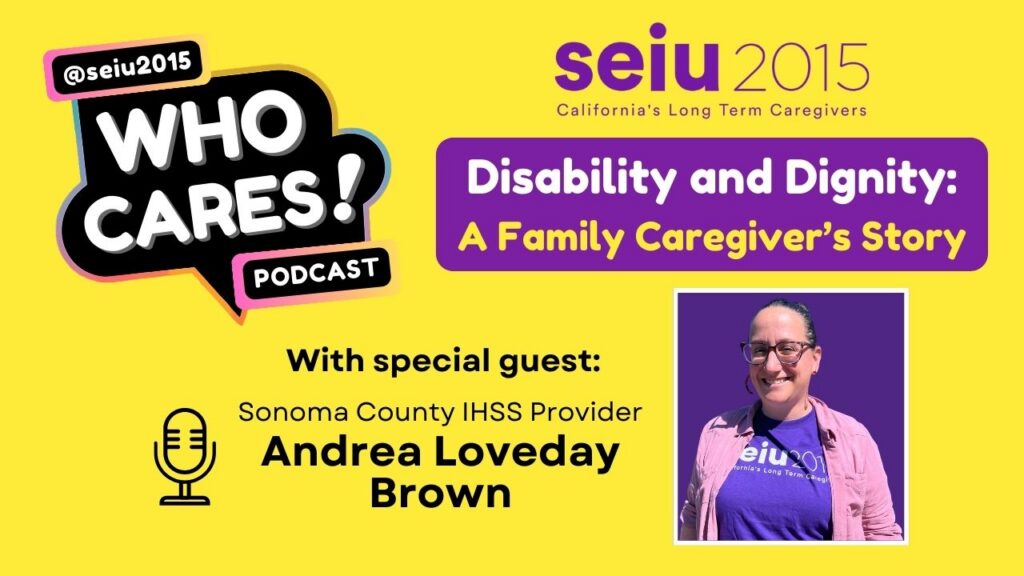
Andrea Loveday Brown is a family caregiver and IHSS provider in Sonoma County whose life changed when she joined the disability justice community and discovered the power of her union. In this episode of Who Cares!, she shares her story of caring for her disabled daughter, her recognition that the crucial work of care often goes unseen, and her commitment to the fight for dignity and respect. Her touching story is a reminder of why caregivers must build power to create a better future for disabled people, immigrant communities, and working families. Follow Andrea’s disability justice account on Instagram at @CenteringDisability.
Transcript
Arnulfo De La Cruz: Welcome to Who Cares!, a podcast by SEIU 2015, the largest union of long-term care workers in the United States. I’m your host, Arnulfo De La Cruz, President of SEIU 2015.
Today on our show, we’re going to do something a little different. Today, we’ll hear the story of a family care provider whose life was transformed when she took part in the movement for a better future of care. And we’ll hear her tell it in her own words.
Andrea Loveday Brown worked with children in after-school programs before she had to leave her job to become a full-time caregiver for her child with disabilities. She eventually discovered the online disability justice community and was empowered by the work of disabled activists and thinkers. Now she’s a mentor to other caregivers with disabled family members, and as a member of SEIU 2015, she took part in the recent campaign to secure a strong new contract for Sonoma County IHSS providers.
Today on the show, Andrea shares the lessons she’s learned while trying to make a better world for those who give and receive care. The fact is, carework and caregivers often go unseen. This is why those in power do not respect the IHSS program and the people, mostly women and immigrants, who do the hard work of caring for others.
While the current Administration is focused on attacking California’s IHSS program, Andrea’s story highlights the real need to invest in care. She works to support her family while also fighting to ensure all care workers get the respect they deserve. And she does this in pursuit of all the values we hold dear in SEIU 2015–worker justice, disability justice, immigrant justice, and the right of everyone to receive quality long-term care.
Andrea’s story marks a sharp contrast with the images we’ve seen of families across the country being terrorized and persecuted. Just last month, a 30-year-old U.S. citizen named Wael Tarabishi died in Texas after his father and primary caregiver, Maher Tarabishi, was detained by ICE. Caregivers like Maher and Andrea provide life-saving care to our most vulnerable and are owed humanity and dignity. Andrea’s story is one of unity and cross-racial solidarity, and is a beautiful picture of what America can and should be.
We look forward to sharing more caregiver stories from across California in 2026. With that, let’s hear from Andrea.
Andrea Loveday Brown: As an activist and a union member, I think the future of care is one in which disability is seen and valued as a part of the human experience, and from that, the people who provide care for disabled folks and the way in which their work allows the rest of the economy to thrive and helps entire groups of people to be independent and live in their homes will be upheld and prioritized. And again, really seen.
My name is Andrea Loveday Brown, and I am an IHSS caregiver for my disabled daughter, and I’m a member of SEIU 2015 Sonoma County. I live in Santa Rosa, California, so it’s a small city at the very top of the North Bay in the Bay Area. It’s situated in wine country, so it’s a bit of a tourist area.
My daughter, April, is 12 years old, and she’s a seventh grader. She was born with a rare genetic condition called Pitt Hopkins syndrome and also 18Q deletion, which is all a way of saying that she’s missing a bunch of genes on the 18th chromosome, and that leads to a lot of different things that are going on with her. So she is physically disabled as well as intellectually disabled.
She’s non speaking, so there’s a lot of tools that are used to support her in communication, like an AAC device, which is essentially her iPad with one of those cool apps a lot of us have hopefully seen by now, with pictures and phrases and also a bit of sign language, and she understands a lot of what’s going on around her. She’s just not able to communicate that back out.
I have learned that the term non speaking is a clearer way of explaining my daughter’s situation. She has a good deal of comprehension of what is going on, but the way her body functions, it is difficult for her brain and her mouth to communicate, and so she’s not able to say most words.
Having said that, she does have a sprinkling of words that she will occasionally say on her own timeline, which has been kind of fun. That’s where giving her all the tools like AAC and sign language come in handy.
DAILY CARE
So April, by nature, is like a very chill, happy kid. And so we can sort of sense if a day might be a little bit off or require more care. Based on her mood, she usually wakes up pretty happy, smiling, glad to see me.
Helping April move through her day involves transferring her out of bed. She has a wheelchair that we use for her to get around in the world, and also what they call an Activity Chair, just a slightly more comfortable, adaptable chair for inside the home, and so she gets into one of her seats by being lifted, and which, you know, becomes increasingly difficult the older and bigger she is.
When I get her up, one of the things that I do care wise is check around her G Tube button. When she was younger, she was not able to eat enough orally, so she had surgery to place a G Tube button in her stomach to be able to provide food through tube feeding. So she got supplemental nutrition that way. And now the button stays there, so that if she’s unwell, we can provide extra fluids, extra nutrition. But on a daily basis, we use it to give medications.
She can feed herself some finger foods. We do have to be careful about some risk of choking or aspiration pneumonia, so we stick with foods that are a little bit softer and easier to chew and swallow. But she is enthusiastic about eating. So she’s really motivated. She loves to try to use utensils, even when it’s not with full success, she enjoys the whole process of eating very much. Takes her breakfast very seriously. Then getting on her braces and her shoes for school and getting her on the school bus, packing up all her stuff for her backpack.
And then it’s sort of the reverse: when she comes home from school, you know, getting her off of the bus, getting her back settled into whichever seating she’s going to be in for a while. And providing support again with eating and getting ready for bed and then starting again the next day.
Because she’s not speaking, if she’s in any amount of pain, it might be through the G Tube being irritated. It definitely might be oral pain. She’s had some delays in her teeth coming out, so sometimes she’ll wake up and she’s grinding her teeth pretty badly, and that’s one of the expressions of pain that is very clear.
If that’s the case. I might use the time that we’re brushing her teeth to try to take a look in there, ask her, using some sign language and some pointing, even with the toothbrush, you know, ask if she’s hurting in certain places, and try to get a sense of what’s going on. That may require, like a pause to consider some extra medication to keep her comfortable, on top of what she takes already to keep seizures at bay.
I think those things can sort of slow a morning down logistically. But kind of more importantly, as a caregiver who’s been doing this for a long time, I have to be careful to take these things more in the moment and not let the cumulative effect of the times when she was younger and more medically vulnerable come into play, where I remember a small indication of pain turned into a larger indication of pain turned into a rising fever, an ER trip, a hospital admission. And as she’s gotten older and stronger, those things happen less often.
But one of the challenges being a parent caregiver is you have to do a lot of work on the cumulative traumatic effects of things like hospital stays and medical emergencies, seizures. You know, things that I’ve witnessed, that her dad has witnessed, that are difficult and impact us deeply. It can be really hard.
I think the flip side of that is also remembering in any given moment you’re going through these procedures, these steps of care that you do over and over and over, day in and day out, and sometimes right in the midst of something like tying a shoe or brushing teeth, I will look at her and she is giving me the most loving, dopey smile, and I realize, you know, she’s fully in the moment. She’s getting my attention, she’s getting her needs met. She’s having a time, and my mind, my adult busy mind, is racing to the things I have to do in my day and whatnot.
Sometimes just something as simple as her big goofy smile will just pull me right back in to slow down, you know, like we can have fun putting shoes on. We can make a game of her threatening to, you know, toss her yogurt off the table instead of me worrying about cleaning it up for the thousandth time. I can use it as a time to connect and have some real fun with her.
DISABILITY/PRIOR WORK
It’s interesting to think about becoming a parent to a disabled child and learning about all the systems that come along with it. Because I was an educator in after school programs for 15 years before having kids of my own, and I worked with really disadvantaged populations and marginalized groups.
And looking back, there were disabled kids there all along. Maybe the language wasn’t there. Maybe I didn’t understand inclusion, and I didn’t understand what these kids were going home to and what the parents were doing to make sure that they had access.
Basically, I worked with kids for a really long time, and never had training on disability, what it means for a child, what it means for a family. We just took, took every kid as they were, and did our best to try to meet their needs.
Becoming a parent of a disabled child, and it was unexpected, and realizing that I wasn’t going to be returning to my previous job, that this was going to become my full time job, and diving into these huge systems was really eye opening. I had never heard of IHSS. I had never heard of the union, that there was a union that supported caregivers in general. I definitely was not aware of the care industry.
So I’d even say for the first about five to seven years of being a parent caregiver, I still didn’t have much connection to the world of disability outside of needing these systems to survive, right? And so it took a long time of getting through survival mode those earlier years to where I started to recognize what I was even doing as part of a bigger system.
As probably most of us have experienced, that eye opening really came through recognizing the failures in the systems and recognizing that being a paid caregiver did not mean I was being respected and honored as somebody that was doing a reputable career. But it’s very intertwined with why caring for disabled people is not considered a job of significance or importance, and that it’s just something that’s assumed that will be taken care of out of survival.
And the truth is, when our families are in survival mode, we’re not able to fight for as much as we wish we could. We have to fight a lot of smaller battles, when what we want to do is things like this coming out and speaking out about how these systems that are intended ideally to hold families up are are barely doing that at best. And so then it feels like, you know, like a hamster, a hamster running in a wheel, like we’re never really making that forward progress.
JOINING THE UNION
So admittedly, when I first became a paid caregiver through Sonoma County IHSS, I joined the union simply out of like a global support of unions, just if I it was the first time I’d had an option to join a union. I believe in them, and I was not involved beyond paying my dues. It’s really been in the last several years, as I become more of a overall disability justice activist and advocate myself that I realized the strength in using that work to support the union in the. Trying to articulate the value of what we do.
It’s yes, there a lot of the specifics of it have been about trying to get a living wage. But at its core, fighting for a living wage is fighting for the government, our society, the greater world to just literally see our value, right? And if you crack that open even more, it’s about seeing our children’s value and adults with disabilities who receive care as well.
And I also have to say that the slightly pessimistic part of me gets gets down sometimes, when I see how many of us there are fighting the same fight, because our unions and our fights for living wages, etc, are all happening in silos, county to county. There is a connection in what we do and that it is a larger union, and it’s exciting to see when there’s big success in another county, but it also is hard because there, you know, there’s an injustice in each county’s access to resources and the right people to be stepping up and and fighting on behalf of others, and it’s just such a tremendous amount of work. And I do feel like there is progress there, which is why I believe in it, and I will keep fighting.
SONOMA CAMPAIGN
Last year, I joined in with a pretty large group of other in-home caregivers to try to get our message across. That was around getting supervisors to raise the wages for care workers locally. We gathered outside of the Sonoma County Board of Supervisors for several hours one day, and unfortunately, didn’t even end up making it onto the agenda, but had some pretty incredible speakers and a chance to come together with other caregivers and share our stories.
One thing that was really powerful for me: it was great to see how far our union reaches. You know, there are people there who care for their own adult disabled children. There was senior care. We were able to just really see the intersection. How many different groups of people were represented from across the county, how many languages were spoken. There were allies from some immigrant rights groups. It was just a really impressive, powerful group of people coming together.
And, you know, one thing I think a lot of us did outside was a little bit of shaking our heads at how the Board of Supervisors, and I’m sure this is the case in many other counties, the board of Supervisors really overlooks the work that we do. Takes it for granted, essentially. You know, care work is that unseen kind of labor, and really predominantly done by women, and even more so women of color, who are out there doing this care work in the homes invisibly, so that effectively, all the other work in our communities can be done by everyone else.
The year prior, California made it state law that fast food workers be paid a minimum of $20 starting wage. And you know, it took that fight last year and all the way up until just a few months ago, for our wage, our County IHSS worker wage, to finally cross over $19 an hour.
And this is actually, in no way to disparage fast food or any other kind of worker. But the point is that if you’re going to be paid by the county for doing this really essential kind of labor, the inequity of the pay just has to be brought to a point where people can make anything near a living wage off of this salary alone. Because I will say that was the other thing, the incredible number of people, the vast majority, talking about how many hours they worked, well beyond 40, and certainly many, many working multiple jobs to survive off of this income. And I was able to really see that firsthand and understand my role and how I’m just connected to all these other people. It was really, it was exciting and empowering, and I would like to think that there could be some larger steps towards some pay equality there.
And I think we’d all love to think that that means that someone out there would be thinking of us and snapping their fingers and automatically bringing us to the same but our union has to continue to do the work and fight. I think that’s the part that’s discouraging, is that the work that is done in the home by IHSS caregivers is it’s so unique compared to other professions, one in that it is almost entirely overlooked as a profession in and of itself, it is not something a lot of people are aware of until they’re in the unique position of either needing care for themselves or a loved one, perhaps a parent, as they age or they give birth and find that they have a disabled child, and they enter that workforce. And I think once you see how caregiving upholds all other professions and everybody else that is out and working in our communities and keeping our economy going, you can’t unsee it.
And so to have this field devalued when the reality is we are often joking amongst ourselves that by now we should have you know, at least half of a medical degree for the amount of you know knowledge that is gained in advocating in the medical world for your child. That we’re all practically school administrators for what we have to take on and learn in order to advocate for our kids in the classrooms and and on and on.
And all jokes aside, you know it’s it’s not only just not a profession that’s valued then to find yourself in it if you’re providing for a family member, but it’s also just very concerning how hard, because of the pay, because of the starting pay, how hard it is to lure in people, to come to attract folks to work in a field that is actually quite dignified, aside from the pay, that is incredible, that’s a wonderful landing place for people that are like very resourceful and creative and love people and have great energy. And, you know, want to work with kids. Want to work with disabled folks. Want to work with the elderly. It’s hard to see how there would even be a track to get people to want to come into the work, not to mention retain them once they, you know, once they’re in.
Honestly, I worked in education for decades, it all reminds me and is so closely tied into the devaluing of educators, teachers, preschool workers. You know, all of it is unfortunately overlooked and taken for granted and leans extremely heavily on, specifically, the willingness of women to continue to do work that is highly underpaid and undervalued.
Part of what gets so discouraging is that we have to fight this fight over and over in so many places. Thank goodness for the Union, for unifying us and helping you know, choose those people that are out there and and doing the hardest of the work. But I just wish that there was a way in which care work could be seen and respected on a more global scale, where so much additional labor didn’t have to happen just to sort of prove everyone’s worth.
DISABILITY ACTIVISM/GETTING ONLINE
I have an Instagram account called centering disability, and that’s really that was the launching pad for me becoming a disability justice activist myself. I started that on Instagram during the pandemic. I was lonely and doing extra intensive caregiving when we were home for longer than the average family. My daughter had to be out of school because of her medical complexities and being at really high risk around covid.
\I just started it honestly as a way to learn first of all, and what I found was I really quickly started following a lot of amazing disability activists and learning about, you know, books and films and all these things to educate myself. That really just launched me heavily towards learning about disability justice and what it is, and the things I was already doing that fell under that and didn’t even know it.
Part of what I’m learning in Disability Justice work is that disabled people have to have a voice. There’s a reason disabled people haven’t been given a voice until, really, almost just in these same last handful of years where I’ve been learning more about disability justice. All of these systems that oppress disabled folks work because people haven’t been able to organize and step up and name the things that have been perpetuating injustice.
So I feel blessed by things like the internet, which, you know, can be a mixed bag, but social media for the disability community is this absolutely vital tool. It’s like a whole world basically opens up as soon as you learn about disability justice and that intersectionality.
And yeah, and through that, through the growth of centering disability and just having a greater reach, honestly, I’ve learned the most from disabled people themselves. I feel like it’s the responsibility, especially parent caregivers, many of whom are non disabled, I think it opens you up to a whole other world. So I feel like to be an effective caregiver, and then to be able to advocate as a caregiver, having disabled adults in your your social sphere is so important. I connect with other parents locally, we have a group called Common Ground society that does an incredible job in Sonoma County of bringing together caregivers in all sorts of ways, socially and to share resources and for all kinds of events, support groups and whatnot.
And then I also work part time for an amazing company called Undivided and that has an online platform. And I work as a navigator. And so for members, I work one on one with clients. I get to meet. With them. And those clients are parent caregivers of disabled children across the state of California, and I can help walk them through all the many complicated systems that we have to deal with as parents, you know, schools and regional centers and hospitals and all of these different avenues, including helping some people go through the process just to become an In Home Support Service caregivers themselves, and talk to them about all the benefits of being able to do that for your family. So it pretty much has, in like, a slow, steady and, like, pretty incredible way, become just the main focus of what I’m doing in pretty much every corner of my life.
Arnulfo De La Cruz: That was Andrea Loveday-Brown, an in-home family care provider coming to us from Sonoma County. Thank you so much for sharing your powerful care story, Andrea. You can follow her disability justice account on Instagram at “Centering Disability”.
And you can follow Who Cares! on all of the podcast apps. To get new episodes sent straight to your phone, search and subscribe to “Who Cares SEIU 2015” on Apple Music, YouTube, Spotify, Amazon, and anywhere else you get your podcasts.
Folks, this moment calls for all of us to stand united against federal attacks on our communities. This moment calls for all of us to be more like Andrea: to tap into our own leadership and help build a movement and a country we believe in. This year we have witnessed increased attacks on immigrants and workers, which are intended to stoke fear and distract from our vision of a world where every person and every worker is treated with dignity. But together, we can achieve justice for the disabled community, for our immigrant communities, for our workers. Together, we can create an America that is more inclusive and affords dignity and respect to every person within our borders.
This has been another edition of Who Cares!, a podcast by SEIU 2015, the union for long-term care workers who keep California safe and strong.
I’m Arnulfo De La Cruz. Take care of yourselves, and take care of each other.